Showing posts with label Meat. Show all posts

Thursday, January 9, 2014

Jakim slams falsifying of halal logo on pictured beer can

KUALA LUMPUR: The Malaysia Islamic Development Department (Jakim) today denied approving the use of the halal logo on alcoholic drinks as depicted on a beer can shown on Facebook and the Whatsapp application.

The department's Halal Hub director, Hakimah Mohd Yusoff in a statement said Jakim had lodged a report on the matter at the Putrajaya police station for investigation.
This followed complaints and information received from the public on the picture of the Carlsberg can of beer with the halal logo on it appearing on the social media.
"We stress here that Jakim has never issued the halal certification or approved the use of the halal logo by the company or on its products. In fact, other products produced at the same manufacturing plant would not be issued with the halal certification or logo even it these are not alcoholic drinks," Hakimah said.
She said action could be taken against any quarters under the Trade Description (Certification and Marking of Halal) Order 2011 for misuse of the halal logo.
"Jakim regards the display of the picture as ill-intended and an attempt to undermine the department's credibility as a body responsible for halal certification in Malaysia and which is recognised nationally and internationally.
"The action will also not only create negative perception of Jais but could also hurt religious sensitivities.
"Therefore, Jakim condemns the falsifying of the halal logo, whether deliberately or with the intention to provoke, which could also create polemic among the public on the matter," she added.
She hoped consumers would not be taken in by false news spread via the social websites by irresponsible quarters and that such misdeeds should stop.
Meanwhile, Putrajaya police chief, ACP Abdul Razak Abdul Majid, when contacted, confirmed having received the police report on the matter.-- BERNAMA


Source: www.nst.com.my

Tuesday, January 7, 2014

Jordan is promoting Islamic/Halal Tourism


Jordan has launched a campaign to attract tourists from Muslim countries to boost the domestic tourism sector, reported the al-Hayat newspaper.

“The board launched a campaign to promote Islamic tourism in Jordan and attract tourists from Muslim countries, especially from Malaysia and Indonesia, given that Jordan is a base and a gateway for holy Muslim and Christian shrines,” said Abdul Razaq Arabiyat, the managing director of the Jordan Tourism Board, in a released statement.

The campaign aims to boost the profile of religious sites in Jordan as an attraction for foreign tourists and seeks to promote religious tourism as “a main source of tourism revenues in the kingdom,” added Arabiyat.

A number of promotional programs have been adopted by the board to attract those Muslim tourists intending to travel to Saudi Arabia to perform the annual hajj pilgrimage, who then continue on with their religious tour by traveling to Jordan and Palestine.

“We’ve signed a number of agreements with tourism companies in Indonesia and Malaysia on visiting religious shrines in Jordan and Palestine… such as the site of the battles of Islamic conquests,” said Arabiyat.

Monday, January 6, 2014

International Halal accreditation centre to open in Dubai

The centre will ensure all products are free from chemical or artificial additives


Dubai will soon have a new International Centre for Halal Food and Product accreditation in compliance with Islamic law.

Hussain Nasser Lootah, Director-General of Dubai Municipality, announced that the civic body will soon establish an international accreditation centre for Halal food in Dubai based on the initiative of His Highness Sheikh Mohammed bin Rashid Al Maktoum, Vice-President and Prime Minister of the UAE and Ruler of Dubai, to make Dubai the world capital of Islamic economy.

Lootah said that an action team has been appointed to work according to administrative decision No 359 of 2013 headed by Salem bin Mesmar, Assistant Director-General, Health, Safety and Environment Monitoring Sector, Dubai Municipality.

The members of the team include Khalid Sharif, Director of the Food Control Department; Amina Ahmed, Director, Accreditation Departmentp; Hawa Bastaki, Director, Dubai Central Laboratory; Noaf Al Naqbi, Head of Certification Bodies, Accreditation Section; Arif Marzouki, Head of Inspection and Certification Section; Maryam Salem Al Sallagi, Senior Food Microbiology Analyst; and Yousef Abdul Samad Al Rashid, Operations Health Specialist.

"The proposed centre will undertake the required tests for Halal food and other products to ensure that all such products are free from any chemical or artificial additives which are not complying with Islamic law, with the aim to be the first international reference in the food industry worldwide," Lootah added.

Salem bin Mesmar said, "A specific centre for accreditation and certification has been already established for the comprehensive systematic coverage of Halal food operations at local level. The current facilities and infrastructure of Dubai will help it easily establish this first international centre in the field of Halal food accreditation."

Tuesday, December 31, 2013

UAE: Halal food gains momentum

The halal food industry is gaining momentum in conventional and non-conventional markets across the globe due to its hygienic and safety qualities, say exhibitors at second OIC Halal Middle East Exhibition and Congress.
The industry stakeholders said investors are increasingly looking opportunities to make investments in halal food products to capitalise growth in this untapped market across many geographies. They also hailed various initiated launched by the UAE government to promote halal industry and said Dubai has strong potential to become the capital of Islamic economy in coming years.
The three-day exhibition and congress attracted exhibitors from non-conventional halal food markets like Italy, South Korea, Russia and Japan, among others. They were upbeat about the outlook of halal food market even in those countries where Muslims are in minority. Over 125 exhibitors and 200 delegates are attending the three-day event, which concluded on Wednesday.
“Halal food is picking up in Italy and we are confident of its success in the country because of its popularity even in non-Muslim population,” Mansur Giuseppe Baudo, audit manager at Halal Italia, told Khaleej Times.
He said Halal Italia is the Italian organisation for Islamic certification and it is also recognised from UAE’s Ministry of Environment and Water and Majlis Ugama Islam Singapura — Islamic Religious Council of Singapore.
“The UAE ministry issued a decree in 2012 to recognise Halal Italia certification, and now our certification is acceptable in all other countries of Gulf Cooperation Council including Saudi Arabia, Kuwait, Qatar, Oman and Bahrain,” he said.
Baudo said halal food is very popular in Italy and playing a key role in establishing close relations between East and West.
bits_12182013Echoed the same views from another non-conventional market, Korea Halal Association advisor Jo Young Chan said halal food prospects are bright in the country. “Our association is a non-profit body that has been formed to provide a common platform to stakeholders in Korea halal industry,” he said.
Chan said the association right now has only 10 members, but due to growing popularity and demand of halal products he is confident of about 200 to 300 members in next five years. “
Halal food industry is growing rapidly in Korea despite low Muslim population and the association will start issuing its own halal certification from next year,” he said.
The exhibitors from Muslim nations are also buoyant about the future of halal food industry and said enormous opportunities exist in this fast growing segment. They underlined the need to uniform standards for halal certifications to realise the true potential of halal trade even in conventional markets of Muslim majority population countries.
“Halal food is progressing well and we see a promising outlook for the industry in coming years,” said Darningsih Rustiadji, director at Indonesian firm Deka Adiguna.
She said Indonesia is a big potential market for halal food and demand for halal products is on the rise as people are more cautious about edibles and shifting towards halal items.
“Halal food is not only for Muslims, it is getting popular even in non-conventional markets in Europe and Asia as we secure orders for our products from Netherlands, Korea and Japan,” she said, and adding that there is need to explore markets in South America.
Rustiadji said Middle East is a big potential market for Indonesian halal food products. “We have more than 100 halal products and secured reasonable orders from Saudi Arabia and the UAE,” she said.
Hamed Abedian, commercial manager at Iran’s Sefid Goosht Hamoon Company, said halal food future is good due to its growing demand and awareness in major markets. “We deal in fresh and frozen fish, chicken and beef. We are participating in the exhibition for the first time and hope to get good business,” he said.
Abedian appreciated the halal exhibition and congress to promote the halal food products and called for more strenuous efforts to explore new markets across the world.

Source: halalfocus.net

Saturday, December 28, 2013

Spain Regulates Halal Food

CAIRO – In a bid to normalize, regulate and control the Halal market in Spain, the Cordoba-based Halal Institute has cooperated with the Spanish standardization authority to develop new regulations related to the growing halal market.
“This is the first time that a Technical Committee on Standardization, addresses technical and religious aspects,” a press release obtained by OnIslam.net quoted Hanif Escudero, the director of Halal Standardization, as saying.
In a meeting held last week, the Halal Institute of the Islamic Board of Spain, based in Cordoba, together with the Spanish Association for Standardization and Certification (AENOR), to agree on the recently developed standardization activity related to halal food.

Escudero noted that the Technical Committee on Standardization AEN/CTN 308 'Halal' is the body created for this activity, whose Secretariat functions will be carried out by the Halal Institute, on behalf of the Islamic Board of Spain.The meeting was held with the support of the main Islamic federations, consumers, manufacturers and the Administration.
The Halal Institute is the Islamic and scientific organization dedicated to normalize, regulate and control the Halal market in Spain.
Escudero added that the Halal Institute of the Islamic Board was the driving force behind the development and signing of the Cooperation Agreements of 1992 (26/1992) and the registrant of the Guarantee Mark Halal (2466790 M 0. Halal).
It is, as has been pointed out, “a global concept that refers to the set of practices and behaviors that are acceptable according to the Shariah/Islamic Law,” he added.
In addition, as indicated by the responsible for the Halal Institute, the normalization process now begun also implies a historical event.
“In the sense that, after 20 years since the signing of the Cooperation Agreements (26/1992), it seems that the subject of Halal will be the first aspect in which there will be a normative progress,” the press release said.
“In other words, we now have an example to follow in aspects that the Cooperation Agreement itself restricts or even left undefined.”
Spain has a Muslim minority of 1.4 million, making up about 3 percent of the country’s population, according to the Islamic Commission of Spain.
Islam is the second religion in Spain after Christianity and has been recognized through the 1967 law of religious freedom.
Growing Market
The new agreement was passed as the halal market continues to hit new successes in the Spanish market.
“The Halal market, at international level, grows by 10/12%, while in Spain has a main consumer segment close to two million consumers, and a market revenue of 620 million euros generated by more than 240 industries, with 500 certified products and more than 600 retail stores,” the responsible of the Halal Institute said.
In the meantime, Aenor technical committees of normalization working bodies announced their willingness to the participation of all interested parties to develop the referred UNE Standards, which are voluntary and demanded by society.
In this sense, the first objective of this new Technical Committee on Halal Standardization “will consist in following-up to a European standard draft on Halal food requirements, the use of additives, animal slaughter and welfare, the traceability or labeling.”
In addition to the follow-up of this European project, the Halal Institute, as Hanif Escudero has pointed out, “has brought up the idea of organizing several working groups to assume other areas, as is the case of beverages, tourism, cosmetics or finances. Emerging sectors in which Spain must also be a reference.”
Another of the reasons for organizing various working groups is that the Committee of the Whole 'is a broad, representative and also diverse body.
The director of Halal Standardization has concluded that, “the working groups are a necessary tool in order to take advantage of the working meetings and all the efforts and dedication put in by the members of the Committee.”
The concept of halal, -- meaning permissible in Arabic -- has traditionally been applied to food.
Muslims should only eat meat from livestock slaughtered by a sharp knife from their necks, and the name of Allah, the Arabic word for God, must be mentioned.
Now other goods and services can also be certified as halal, including cosmetics, clothing, pharmaceuticals and financial services.
Halal food is consumed not only by 1.5 billion Muslims around the world, but also by at least 500 million non-Muslims in the $2 billion global industry.


Source:www.onislam.net

Tuesday, December 24, 2013

Pakistan all set to capture international halal food products market

ISLAMABAD: The Ministry of Science and Technology (MoST) is all set to take steps to foster halal industry of Pakistan and to capture the international Halal products market worth US$ 3 trillion.
An inter-ministerial meeting would soon be convened in this regard, to expedite the progress on Halal food and making the industry compliant to international standards.
“There is strong need of developing standards and enacting a law to advertise our Halal products, and will boost our export especially in Middle East and Europe”, a Ministry official told APP.
He said Pakistan needs Halal professionals because globalization of food trade and increased consumer awareness regarding food safety standards contribute towards new demands for halal, healthy and hygienic food.
“We possess all imperative elements for Halal products’ production and have to streamline them at par, the demand of the target community”, he added.
He said creation of Punjab Halal Development Agency (PHDA) is a step toward making Pakistan, Halal hub by opening new vistas for entering the global Halal market while serving the domestic consumer market.
The demand for healthy and safe agro-livestock food products is increasing rapidly with increasing population growth rate and socio-economic conditions.
This will also open up new economic opportunities and employment for the youth and traders. PHDA, being a leading entity of government of the Punjab is established to prescribe standards and processes for Halal Certification of food and non-food sector in line with research and advanced laboratory testing facilities.
Official said the Ministry of S&T will promote Halal Industry of Pakistan worldwide by maintaining International standards, adding Halal Standards for Livestock, Beverages, By-products, Cosmetics and other edibles will also be introduced, which will build trust on Pakistani products and enhance export volume.

Source: Aaj TV

Saturday, December 21, 2013

British Muslims develop appetite for halal turkey

Covered in blood and Urdu script, the traditional halal butcher’s shop has catered to generations of Britain’s Muslims – serving up a platter of chicken, lamb and beef to mostly foreign-born customers.

But in a sign of changing consumer habits, they have taken to selling halal turkeys, as growing numbers of practising Muslims gobble up roast turkeys for Christmas dinner on the Christian feast day.

Last December, the Halal Monitoring Council certified 5,500 turkeys slaughtered in UK abattoirs. In 2011, they certified none. Last week alone, the HMC certified 1,500 turkeys.
Demand has taken many suppliers by surprise.
“I was shocked there was a market at all,” said Paul Kelly, managing director of Kelly Bronze Turkeys.

Ben Bayer, an executive at wholesaler DB Food, says there is “huge demand” for halal turkeys, but they are unable to meet it, as the UK’s biggest halal assurance body, the Halal Food Authority, does not yet certify any turkeys as halal.
Muslim butchers instead mostly import halal turkeys from Ireland and Italy. These are now even available at Smithfield Market in London.

A Financial Times survey of 20 halal butchers based in London, Lancashire and Essex found that over half sold halal turkeys in December – some for the first time this year.
JR Butchers in Tooting says it is on track to sell 2,500 turkeys this December – a 4 per cent rise on last year.

It is relatively recently that turkeys have waddled into the UK’s £2.6bn halal meat market, as estimated by the World Halal Forum, which is growing exponentially as the Muslim population grows.

Research by Eblex, the meat industry body, shows that Muslims constitute less than 4 per cent of Britons, yet account for 12-15 per cent of British meat consumption.
Turkeys are representative of the flush nature of an expanding market, which Javed Rashid, a partner at JR Butchers, describes as “the high end of halal”. It encompasses increasing Muslim demand for halal geese and halal free-range products.
“These are home-grown Muslims with a higher disposable income than their parents’ generation and are more at home with British customs – without compromising their faith,” said Noman Khawaja, founder of the Halal Food Festival who uses the term “haloodie” to describe these new halal “foodies”.

Businesses are increasingly catering to this market. Mr Rashid aims to give his customers “an education in meat, which old-fashioned halal butchers are unable to provide – they lack the product knowledge”.

Fast food outlets have long served halal meat in areas with a high Muslim population. Now more upmarket restaurants, from the PizzaExpress chain to China Tang in Mayfair, have halal menus, too.

John Man, senior manager at China Tang, believes that it is important the luxury restaurant “reflects its customer profile”, adding that “the quality of halal meat is always good, when other meat sometimes fails to meet our standards”.
The increasing diversity of the UK’s halal meat market reflects a bigger, worldwide trend. Last week, a Norwegian supplier of Scandinavian game meat unveiled the world’s first halal reindeer – enabling Norway’s Muslims to taste the traditional yuletide meat for the first time.

Source: www.ft.com

Wednesday, December 18, 2013

Halal Research Council and KPK Agriculture University Signed Agreement

A strategic partnership agreement signing ceremony between Halal Research Council (HRC) and KP Agriculture University was held on Thursday in which the experts from food, nutrition, livestock and other Industries were participated. According to the agreement, Halal Research Council and KP Agriculture University will provide joint consultation, training, research and technical assistance to each other for the promotion of Halal industry especially in Khyber Pakhtunkhwa province. 

The strategic partnership agreement was signed by the Chief Executive Officer of Halal Research Council Muhummad Zubair Mughal, Professor Dr Khan Bahadur Marwart Vice Chancellor of Khyber Pakhtunkhwa Agriculture University and Professor Dr M Subhan Qureshi-Dean Faculty of Veterinary Sciences. 

As per the agreement, Halal Research Council will provide international linkages and Halal certification services to Khyber Pakhtunkhwa Agriculture University in Khyber Pakhtunkhwa's Halal related industries. Professor Dr Khan Bahadur Marwart Vice-Chancellor of Khyber Pakhtunkhwa Agriculture University, addressing the agreement signing ceremony, said that nowadays distinction between Halal and Haram has become a big issue and organisations like Halal Research Council has smoothen this issue for general public through its expertise. 

He further added that due to this agreement between Halal Research Council and KPK Agriculture University, Halal Industry in Pakistan and particularly in Khyber Pakhtunkhwa will progress rapidly. Professor Dr M Subhan Qureshi Dean Faculty of Veterinary Sciences said that Khyber Pakhtunkhwa has a specialty that livestock is in abundance here. Khyber Pakhtunkhwa is a mountainous area, hence, meat is available in excess here relatively to dairy; and substantial amount of profit can be earned by exporting meat in the international market with Halal logo. 

Muhummad Zubair Mughal the Executive Officer of Halal Research Council said that the Halal Research Council's agreement with KPK Agriculture University will be a milestone in the development of Halal Industry, due to which educational and training efforts along with trade and advancement in Halal sector can be further strengthened. He said that Pakistan's Shariah values are acknowledged all over the world. If we export Halal meat, poultry, dairy, confectionery, spices and other food products from Pakistan to international market, then they will be highly recognised due to our Shariah values. 

Tuesday, December 17, 2013

Channeling Halal food potential

AnalysIs - Halal industry is a fast emerging business in the world, attracting both Muslims and non Muslims, especially non Muslims due to realising the importance of halal food. As expert have opined that they are safer, hygienic, nutritious, having high quality and reliability. Halal food is consumed not only by 1.5 billion Muslims around the world, but also by at least 500 million non-Muslims, which shows that there is a big scope to enter in the halal food industry, to tap the world market. It is estimated that the annual halal food and non food products market is about $2.1 trillion of which about $80 billion is being exploited, which is 5 per cent of total trade of agri-food products. However, halal food trade may have a share of 20 per cent of world trade in food products in near future. While the market for about 1.4 billion Muslims already exists, the demand for halal products is now on the rise across the globe.
Due to lack of awareness about halal products in Pakistan, we hardly have any share in the global market of $600 billion. The Thai consul general in Pakistan said over 1,800 factories are producing 57,000 different halal food products for exports after acquiring Halal Certification from authorities with advanced research facilities. There is great scope of setting joint venture in halal food sector between Pakistan and Thailand. He assured all possible help in setting up joint ventures with Pakistani companies.

Chile a hub for Halal Food

Chile's ambassador in Malaysia said the number of halal certified Chilean companies had grown from 25 to 45 within the first quarter of this year. It was claimed that the country can compete with any country as its halal products are of high quality. Chile had exported many of its halal meat products to other Islamic countries including the Middle East and Muslim African countries. 

Halal units in China

In Ningxia, China, Muslims account for around 38 per cent of the province’s 6.3 million residents. The province recently announced that it had developed a halal industry to accommodate not just the needs of Chinese Muslims but also Muslims in other countries.
Ningxia’s halal food commission said that the province had more than 10,000 factories and restaurants that were certified halal products. The region’s halal industry, which is supported by a high tech laboratory, 15 experts and 300 staffers, was currently worth up to 50 million RMB.

Engro expanding Halal Trade

Engro intends to acquire Al Safa Halal unit. It will target the existing North American market, Canada and USA. Pakistan and Malaysia have decided to utilise various options available under the Free Trade Agreement (FTA) to boost economic relations and broaden the scope of bilateral trade, signed in January 2008. Pakistan Malaysia Business Forum is exploring opportunities for joint ventures in sectors such as agriculture and halal industry which offered better returns and greater scope for growth given a growing demand for quality food and halal products in the region. 
Zubair Motiwala, Chairman Sindh Board of Investment (SBI) said that Pakistan is going to start issuing halal certification by March, 2012.
He said the SBI in collaboration with Halal Industry Development Corporation, Malaysia, is working to develop halal industry and is committed to effectively implement the provisions of the MoU signed between the two parties on Dec 1, 2010, in Kuala Lumpur, for development of Halal sector in Pakistan. Pakistan can benefit from the halal standard, advance scientific knowledge and research experience of Malaysia for developing and promotion of its halal products industry. Pakistan is the sixth largest milk producer, eighth in meat and tenth in poultry had a negligible share in the world halal food and services market. 
However, Pakistan is trying to develop halal services such as finance and banking and could easily develop other products in sectors like pharmaceuticals, insurance, etc. 
The experts say that the important factors are the standardisation and certifications of halal brands and logos which would make Pakistan hub of halal trade for the world and for the region, due to the proximity of Middle East and central Asian countries. 
Moreover, halal food should be made tasty and pleasant with no chemicals and nice looking to attract consumers the world over and to compete haram food that is being made attractive for consumers to capture markets.

Export potential

Pakistan can earn huge amount by investing into halal meat and exporting it after meeting local demand. European market size of halal food is about $66 billion while France having the largest share of $17 billion alone, stated by the Vice Chancellor University of Agriculture, Faisalabad. He also said that only in UK the halal meat sale is amounting to $600 million annually while the American Muslims spend $13 billion on halal food per annum.
The livestock contributed 55.1 per cent to the agriculture value added and 11.5 per cent to GDP during 2010-11 while its share last year was 53.2 per cent of the agriculture value added and 11.4 per cent to national GDP during 2009-10.
In the current scenario of devolution under 18th Amendment, the responsibility of livestock development has been shifted to provinces and federal government will play facilitating role in national interest. The future plan for livestock sector is to meet MTDF targets for meat, 5.0 per cent and milk 8.0 per cent production through shifting from subsistence livestock farming to market oriented and commercial farming with a focus on entire market chain. The future plan also includes entering into global halal food trade market. 
Zubair Motiwala, Chairman Sindh Board of Investment (SBI) said that the Pakistan is going to start issuing Halal certification by March, 2012.

Halal food certification system

The ministry is planning to create a halal food certification system in Pakistan. The system would help the country earn at least $600 million by exporting of halal products. Presently, there is neither halal infrastructure, nor a qualified certifier and whatever is to be exported in the name of halal has to be certified by a foreign inspection body, mainly Malaysian companies.
On August 18, a MoU was signed between Halal Research Council and Faisalabad Industrial Estate Development (FIEDMC) for the establishment of M-3 Halal Park at the estate. It will be Pakistan’s first Halal park and from here Halal products can conveniently be exported. Such parks already exist in Malaysia, Yemen, Britain and Russia.
A state-of-the-art facility is being set up by PAMCO costing $300 million with the cooperation of Iran, M-3 Halal Industrial Park at Faisalabad. A Halal Laboratory would also be set up at University of Veterinary and Animal Sciences (UVAS), Lahore. 
An industrial park is proposed to be set up in Karachi to facilitate growth of an export oriented halal business. The park will be a cluster of halal business industries to be built in a special zone where they will be provided infrastructure and halal related support services. For this purpose, the SBI has signed a MoU with the Halal Industry Corporation (HDC), Malaysia in December, 2010 at Kaula Lumpur.
The ministry of commerce imposed a ban on export of meat and live animals in July 2011 for three months to bring down the prices of beef and mutton which were becoming unaffordable for the common man. Although it was said that the purpose of the ban is to provide relief to the consumers but officials said that the decision was taken to meet the demand of Pakistan Tanneries Association (PTA) whose members were facing the problem of shortage of hides and skins and high prices of raw materials, due to export of animals. They said exports of leather products fetch much more foreign exchange than those of live animals.

Export of meat products
According to the Federal Bureau of Statistics, Pakistan’s export of meat and meat products touched the figure of $153.8 million in 2010-11, showing an increase of $99.3 million over the previous year. The official statistics indicated that 95,523 live animals were exported during 2010-11, July-March. About 153,543 animals were exported in the previous fiscal year which included 48,680 cattle, 50,000 buffalos, 54,716 goats and 147 camels. These were exported to Arab countries, Central Asian states and Afghanistan. There is no clash of interest between the two industries. The ban should have been restricted to animals only, sparing the meat. The export of tanned leather increased from $341.8 million a year ago to $462.3 million in 2010-2011 and that of leather products rose from $458.6 million to $540.5 million.
Malaysia’s Department of Islamic Development has approved the Islamic Foundation Bangladesh (IFB) as a Halal certification body and, Bangladesh will soon start exporting halal food and other products, competing with Pakistan in this sector, besides textiles. The IFB has been included in the list of halal certification bodies worldwide, i.e. Bangladesh would take its share from the $660 billion global market for halal food.

Emerging global market
The emerging global halal food market has plenty of opportunities for further growth. Thus, the market represents a strong economic opportunity for Pakistan and Thailand. The Thai government has lent the industry valuable support in developing a world class halal logistics system. Thailand is currently the world's sixth largest exporter of halal food, accounting for $5 billion in international trade and providing food to 1.8 billion Muslims in over 157 countries. As a large Islamic nation with strong agricultural base and good relations with Muslim countries Pakistan may be a leading player in halal food trade. 
Punjab Industrial Estate Development and Management Company (PIEDMC) and the Government of Malaysia have signed a MoU for the promotion of halal product projects, which will help Pakistan in boosting halal products’ exports. Pakistan is among the top five milk and livestock producing countries in the world. Therefore, Pakistani businessmen can avail this opportunity. PIEDMC Chairman S M Tanveer pointed out that the dairy and livestock sectors currently performs well below its true potential. Pakistani halal food, which also includes poultry products, has vast export potential in European and other Western countries. The exports can be enhanced manifold in future, provided the sector receives official recognition. The private sector exporters of halal food said through adopting modern techniques and bettering sanitary certification procedures, the halal food exports could fetch more than $100 million in next two years for Pakistan, besides other products. - See more at: 


Source: 

Pakistan Today

Sunday, December 15, 2013

Global Halal Meat Market volume reached up to $ 300 billion: Zubair Mughal

Brazil, America, Australia and India have substantial market share in Halal meat Industry.


(Lahore) Halal meat market is growing rapidly throughout the world and its demand is increasing day by bay, Pakistan ranked 18th in the production of Halal Meat Market and its volume is only 2.9 % of the global Halal meat production which is very low, These views were expressed by Muhammad Zubair Mughal, Chief Executive Officer-Halal Research Council, he mentioned that Pakistan can play pivotal role in this growing market because Pakistan have more than 160 million quality live stock including 71 million Cattles & Buffalos and 89 million goats & sheep’s.

He pointed out that there is no Muslim country is included in the list of first ten Halal meat exporters, although Pakistan, Sudan and other Muslim countries have big potential of exporting Halal meat globally. He said Halal meat is not only the name of meat but more than 26 Halal industries are also based on bi-products of Halal meat e.g. Casings, Bone crashing, Gelatin, Sausages, leather and other industries are associated with it.

He further explained that to strengthen the Global Halal meat industry, Halal Research Council is going to organize an international workshop on Halal Meat which will be scheduled on 26th August, 2013 in Dubai – U.A.E. In which renowned expert, Prof. Dr. Javaid Awan - Agriculture University Faisalabad, Nasib Ahmad Saifi - Chief Executive Officer- Anis Associates Pvt. Ltd and other International speakers will limelight the need and importance of Halal Meat, Fundamentals of Halal certification, Animal welfare and stunning, Impact of Halal slaughtering on meat quality, Pre- and post-slaughtering procedures, Global market and demand for Halal meat, Strategies to increase the share of Halal meat in global meat market, Livestock management for Halal meat, Slaughterhouse automation - machinery, tools and training and Utilization of halal meat in the production of processed and semi-processed food items. The main aim of this Int’l workshop is to promote the trade and importance of Halal Meat at International level. Halal meat exporters, Veterinary Doctors, Shariah Scholars, food technologists and hotel industry will get benefit through this workshop.

Halal Research Council (HRC) is a Pakistan based think tank working for the development of Halal Industry through research, advisory, advocacy, market intelligence & Capacity Building. HRC working globally with the help of 28 International strategic partners which are based in USA, U.K, Kenya, Malaysia, Pakistan, Spain, Germany, India, Bangladesh, Sweden and other countries.

Saturday, December 14, 2013

Pakistan a small player in global halal meat market

LAHORE: 
Pakistan is one of those countries in the world where climatic and other conditions support the livestock industry, but this industry lacks modernisation and is still a long way from becoming a leading player in the rapidly growing global halal food market.
In an attempt to give a boost to the industry, the government has made some efforts in the past few years, especially in Punjab, where the Punjab Agriculture and Meat Company (Pamco) has been established. However, it has yet to give desired results.
The private sector has been involved in this industry, but not aggressively because of issues like taxation, freight rates, energy crisis, etc. The industry needs modern and hygienic slaughter houses that can meet international standards for export of chilled or frozen red meat to countries where demand for halal meat is growing.
Pakistan is ranked 19th in terms of meat production with an annual output of 2.2 million tons. In the three-trillion-dollar halal product industry of the world, the meat segment is worth $600 billion. Pakistan’s share in it is only $115 million.
Meat exporters believe that this figure can be tripled with the right policies.
“The industry is in its initial stages in Pakistan, with literally 0% contribution to the global industry, we need relaxation in taxes, less interference from provincial departments and a clear policy to boost the industry,” said Nasib Ahmad Saifi, Chief Executive Officer of Anis Associates, a sister concern of Saifi Group, while talking to The Express Tribune.
The group is one of the largest exporters of meat in Punjab, whose export revenues have crossed $15 million annually.
“Rising tax rates, zero rebate, high freight charges and above all energy crisis are hitting us hard, otherwise our company has the potential to at least triple its export volume,” Saifi said.
He believed that total meat exports of the country could reach $500 million if the government started taking interest in this industry. Citing the example of India, he claimed that the neighbouring country, which is not even an Islamic state, was exporting halal meat worth $23 billion annually just by properly organising the industry.
He highlighted smuggling of live animals to Afghanistan and Iran as another problem that has been hitting the livestock market.
According to Pamco, around 2.5 million live animals worth $1.4 billion are smuggled every year, dealing a damaging blow not only to domestic meat sales, but also to exports.
Saifi stressed that if smuggling was brought under control, the export of red meat would grow and prices would also come down in the country.
This will also provide a boost to the local leather and tannin industry which will have access to high quality hides at lower cost. In fact it has been a long-standing demand of the local leather industry to limit livestock exports and to promote meat exports.

Source: Tribune

Friday, December 13, 2013

Pakistan can be superpower of world Halal market: Malaysian Minister Haji Abdul Malik Kassim

Exports of meat from Punjab to Malaysia have picked up recently.
Two months ago, Malaysia’s state minister for religious affairs and domestic trade Haji Abdul Malik Kassim, while on a visit, had stated that Pakistan can play a major role in the global halal meat industry. Halal meat contributes about 16 per cent of total world trade of the commodity.
It is only in recent years that Pakistan has begun to realise the importance and export potential of halal food. In fact no Muslim country features among top 10 halal meat exporters. The market is dominated by multinationals of the western countries. According to a survey, the global Muslim population is around 1.86 billion, which constitutes 30 per cent of the total world population. The volume of overall halal products, which was $635 billion dollars in the year 2010, is estimated to have reached $2 trillion.
Pakistan ranks 18th in the production index of halal meat market and its share is only 2.9 per cent of the global output. That Pakistan can do more is evident from the fact that it has 71 million cattle heads and buffaloes and 89 million goats and sheep.
The government could help raise halal food exports by formulating sound policies in collaboration with the private sector. The existing exports are no match to the country’s annual output of halal meat or its export potential. Local businessmen estimate potential of halal products at $5 to $6 billion, if incentives are provided by the government to encourage export of good quality food products. One may note that India, not a majority Muslim country, is also an active player in the halal food market and its exports have reached $23 billion per annum.
Lahore Chamber of Commerce and Industry claims that halal meat exports from Punjab have made remarkable progress over the last few years owing to positive steps taken by the provincial government.
The Punjab government has also started work on halal certification which can go a long way in further facilitating exporters of halal products. It is claimed that about 50 halal certified companies have emerged in recent past and are now engaged in export business and that there are also state-of-art halal slaughter houses in the province complying with international best practices.
Some companies are using Australian technology and their beef and mutton plants are equipped with the most updated systems available. Their main customers are from Saudi Arabia, UAE, Oman, Qatar, Kuwait, Bahrain and Iran.
However, exporters of halal food products complain of a few hardships. They demand they should not be subjected to unjustified taxes and prolonged gas and power loadshedding and be freed from bureaucratic hassles.
Pakistani exporters should also ensure that their products fully comply with the strict safety codes of meat importing countries. Many companies suffer from lack of technical know-how in processing, storing, transporting and marketing of meat and its products. It is for this reason that Halal Research Council (HRC) was recently established and empowered to issue halal certification and assurance programme.
HRC is a Pakistan-based organisation working for the development of halal industry through research, market intelligence and capacity building. It is working globally with the help of 28 partners based in several countries.
A local certification programme pursued by another such body, namely, Halal Industry Research Centre (Shariah Board) is adopting a professional approach to follow Islamic laws. The Centre employs the services of some scholars from Binoria Town, Karachi to determine correct interpretations. If the scholars see no harm in a particular business process, it means the company has complied with all the standards under Pakistan Halal Standards and is issued a certificate.
Pakistan has, meanwhile, approached food importing countries, including the European Union and Gulf countries, to seek recognition as a halal meat exporting country with specific reference to value-added chicken products.
A research report released this month says that global halal food market is set to grow at 4.44 per cent during 2012-2016. One of the key factors contributing to this market growth is the increase in the Muslim population. The market has also been witnessing increasing R&D in halal product innovations.
However, the decrease in the integrity of halal foods could pose a challenge to the growth of this market. The research report by ResearchMoz is based on an in-depth market analysis with inputs from industry experts from different countries.

Refference: Pak Observer and Daily Dawn.
                 

Thursday, December 12, 2013

Halal Accreditation will Introduce Pakistani Products around the Globe

The Role of Pakistan National Accreditation Council (PNAC), in this regard is commendable which will help in the growth of Halal Exports:  Zubair Mughal

(Lahore) The step of introducing Halal Accreditation Scheme by Pakistan National Accreditation Council (PNAC), Federal Ministry for Science and Technology is commendable which will help introducing Pakistani Halal products globally hence will increase the exports as well. These words were expressed by Mr. Muhammad Zubair Mughal, Chief Executive Officer – Halal Research Council in a seminar on the topic of Halal in Lahore. He said that due to non availability of Halal accreditation in Pakistan, Pakistan’s Halal Certification Agencies were facing many difficulties at national and international level. He said that despite this fact that Pakistan is facing different international propagandas, there is a positive side that Pakistan’s Religious prestige and authenticity is endorsed and highly recognized all around the world and international communities gives vital importance to products certified & Exported by Pakistan along with the Halal label.

He said that this accreditation will not only help Pakistan to increase the exports of Halal food, meat, dairy products, chemical beverages and spices but also would help to promote the non food products like Halal Cosmetics, Chemicals, gelatin, pharmaceuticals and Halal Tourism. He further added that Pakistan Standard and Quality Control Authority have issued two standards, PS: 4992–2010 and PS: 3733–2010 in which PS: 3733-2010 relates to management and procedure of Halal food for Halal Food industry whereas PS: 4992-2010 is related to general procedure of Halal Certification Institutions.

He said that Halal Research Council is a registered institute under Joint Stock Company Act, 1860 which primarily works for Halal Certifications, Research & Education, Training, Advisory and Consultancy whereas its strategic partners are providing the services of Halal certification in Malaysia, Italy, UK, Philippine and Mauritius.

Wednesday, December 11, 2013

MoU signed Between Halal Research Council and Malaysia

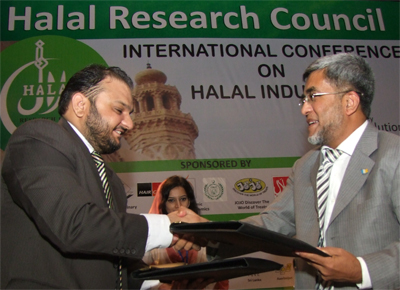
The ceremony held during International Conference on Halal Industry at Expo Centre Lahore and Zubair Mughal, CEO, Halal Research Council Pakistan and Haji Abdul Malik Kassim, State Minister for Religious Affairs & Domestic Trade Penang- Malaysia.
Lahore (Press Release) “International Conference on Halal Industry” was organized today at Expo Centre, Lahore – Pakistan. The conference was inaugurated by Haji Abdul Malik Kassim, State Minister for Religious Affairs, Domestic Trade & Consumer Affair Penang Govt.- Malaysia in which speakers and researchers from America, Australia, U.A.E., Romania, U.K. and South Africa participated to deliver their valuable knowledge& Research about Halal Industry. The point of interest was the MoU signing ceremony between Halal research Council and Malaysia for the promotion of Halal industry, the establishment of Halal Industrial Park, the easy availability of Pakistani Halal products in Malaysian market and the exhibition of Pakistani Halal certified products in Malaysian market.

Addressing to the audience, Haji Abdul Malik Kassim, Religious Affairs, Domestic Trade & Consumer Affair Penang Govt.- Malaysia said that the MoU signing is a very significant occasion. He further added that Halal food market is very rapidly increasing market and Malaysia is playing a momentous role in this regard. During the occasion, Muhammad Zubair Mughal, Chief executive Office, Halal Research Council, Pakistan said that the MoU will prove to be a bridge between Pakistan and Malaysian market through which we will be able to brand our products on International platforms. He said that the main purpose of this conference is to introduce Pakistan among international market so that it could play its technical & Shariah role in this highly distinguished market of more that one trillion dollars worth.

Many national and international speakers delivered their valuable research works and speeches on this international conference in which Haji Bill Yahya Ibrahim Aossey, Founder and Senior Director, Regional Representative Islamic services Of America America, Engr. Shaukat Hussain, Director General, Pakistan National Accreditation Council (PNAC), Islamabad, Pakistan. Mr. Alaa Kamal, Regional Representative, Of Islamic Service of America Dubai, Dr Muhammad M Khan, Food Technologist, (Canada), Executive Director, Halal Australia Halal Consultant Australia, Mr.Dorin Ecea, Development of the Halal Industrial Park, Halal Assets Council in Romania, Romania, Haji Abdul Malik Kassim, Minster of Religious Affairs, Penang- Malaysia, Mr.Hamid Ahmad, Halal Slaughter and Animal Welfare, Ex-Principal Scientific Officer, Biotech. and Food Research Centre, Pakistan Council of Scientific & Industrial Research (PCSIR), Lahore, Dr.Hamid Talil, Chief Executive officer, Lahore Meat Company, Lahore, Dr.Shazad Afzal, Director, Pakistan Standards & Quality Control Authority, Ministry of Science & Technology, Government of Pakistan, Lahore, Dr. Zubair Usmani, Shariah Advisor, MCB Limited. Pakistan, Capt. M. Jamil Akhtar Khan, Managing Director, Universal Insurance Company, Mr.Raheel Iqbal, Chief Executive Officer, Halal Industry Research Centre, Karachi-Pakistan. Prof. Dr. Faqir M. Anjum, Director General, National Institute of Food Science and Technology, University of Agriculture, Faisalabad- Pakistan, Prof. Dr. Javaid A Awan, Country Director, Islamic Food & Nutrition Council of America, Dr .Shahid Raza, Chairman, Bio world Forum. Pakistan, Mr. Mashood Ahmed Siddiqui, Manager products, Vectra foods, Karachi-Pakistan, Dr. Muhammad Jamil Khattak, Chairman Department of Microbiology & Biotechnology Kohat University, Pakistan and other speakers participated their thoughts on Halal Industry, Halal Food, Halal Tourism, Halal Slaughtering and Halal Banking etc. It is to note that Halal Research Council is an organization working nationally and internationally on Halal certification and accreditation, research and education.